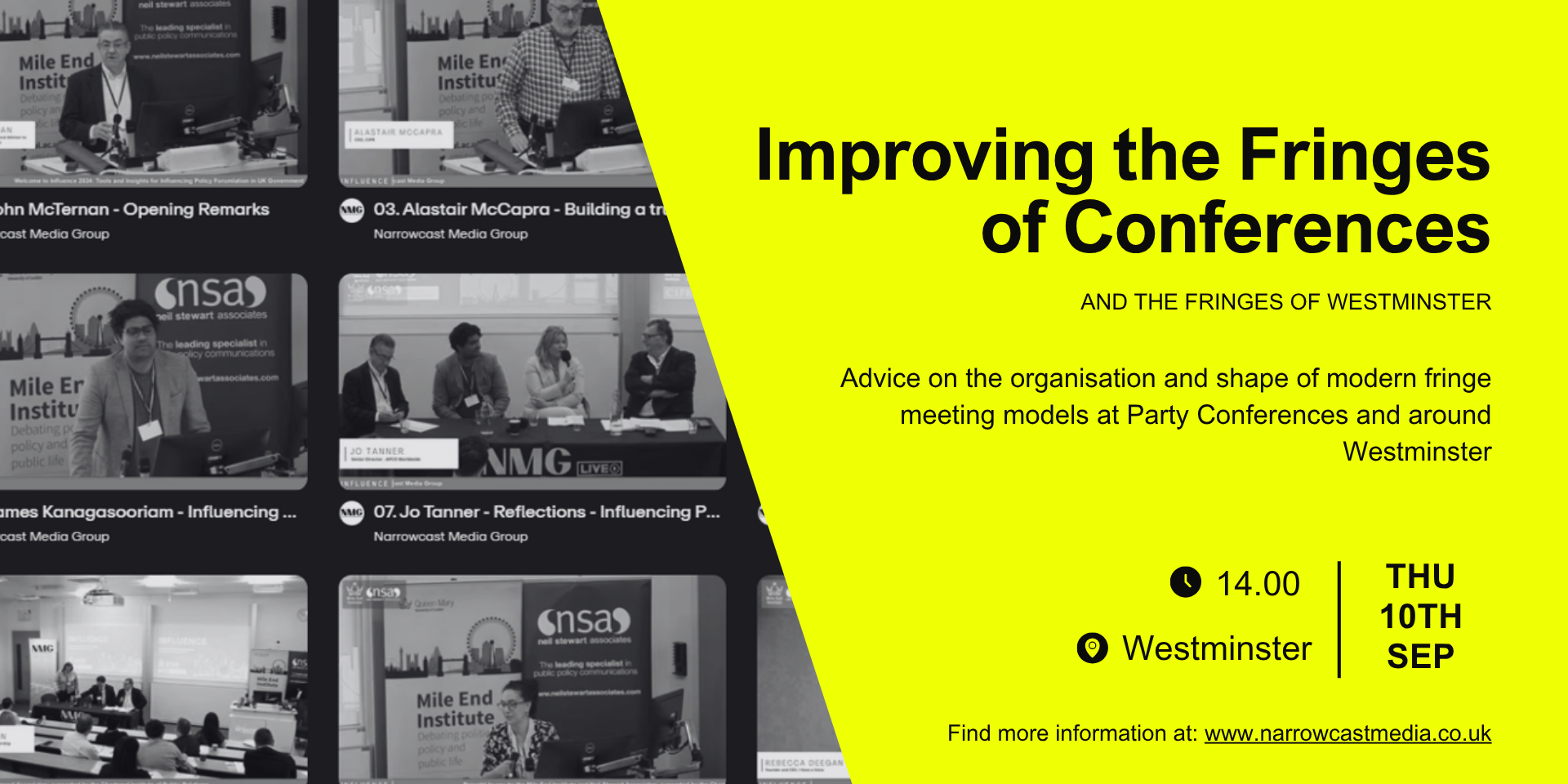
Getting more from the Fringe of Party Conferences?
Fringe meetings at party conferences are getting a sceptical press on their value.
More organisations are now holding their meetings outside secure areas.
Others are worried about getting drawn into repeating just out of habit, not top value.
Does that describe you, doubting the value and the effort of the expensive fringe meetings and the challenge of getting the right audience?
The up side for public affairs and in house government relations professionals is it’s still a great venue, lots of picking up vibes, lots of networking with other public affairs people, spotting new trends, just enough contact and hearing government insiders and ministers, picking up intelligence to keep clients and members happy.
Political party conferences have changed massively over the past years from the chaotic Labour membership rallies of trade unions, professions, councillors, at Blackpool to Conservative association ladies, giant business leaders, councillors, charities, professional bodies and estate agents at the Tories in Brighton or Bournemouth.
In days gone by where there was also the TUC plus the SDP and the Liberals, it was possible to be on the road for 5 or 6 weeks, if like me you also had to attend the SNP.
But they were essential events for networking, making contacts, raising profiles and, above all, exerting influence. When I was at the Royal College of Nursing I remember one Party Conference taking place in Brighton whilst we were embroiled in a row with the government over pay. We were able to secure an extra £39 million from the Chancellor in a single morning—equivalent to 0.5% on pay. It was a remarkably effective way of ensuring that our campaign did not overshadow his conference speech.
Later working for Labour I helped restructure the annual conference, exhibition with the innovative Michael Cunnington, charging more than the Conservatives, introducing business days and expanding exhibitions, dinners and sponsorship creating themed hubs.
We did so much work on other people’s conference models that Francis Maude MP later got me to draw up proposals on reforming the fringe at the Tory conference, where he thought, and he was right, all the interesting speeches were being made but not captured for members .
The peak of political conferences as festivals for everyone were probably the late 1990’s where the Labour Conference in Brighton was attended by 25,000 people. Yes, a conference of 1500 delegates surrounded by a further 23500 delegates, a festival of politics and business, media with embassies, personalities, corporate and city leaders, regional bodies, councillors, every charity and think tank all paying, networking, and getting great value in days before smart phone, internet livestreaming. At one point the mobile phone system packed up, it was so overwhelmed by the numbers.
Then the Independent Newspaper paid Labour an estimated £25,000 to put its paper on delegate seats every day. It created a problem, Labour had changed the law about donations to political parties without studying the detail. The other newspapers lambasted the Independent for “donating to Labour”. But, they protested, it was only a commercial contract. Read the law said the other paper, and indeed any payment to a political party had to be declared as a donation and should also appear in corporate reporting.
Crash! Companies and public bodies ran for cover – it was only a few years after the Neil Hamilton cash for questions horror show – policy questions were asked at board meetings, some spending, especially at the Tories, but also Labour was big and embarrassing to companies in public. A clamp down followed. But the conferences carried on, albeit in a fundamentally changed way. And likewise the fringe changed as a consequence.
Now companies and in house teams switched to working only through their public affairs companies at arms length. Think tanks had a boom time running corporate sponsored sessions at arms length from the political parties, charities got new sponsorship pipelines and handled all the delegate payments and accreditation at arms length and the wheels turned again, but on a smaller scale. Labour invented special business days and invitation only events. Conferences settled down to something smaller.
But there was a loss. Many of the councillors and big business leaders no longer felt they could attend. Some charities stopped. A great many quangos and regional bodies promoting investment or tourism withdrew. The corporate spending never again returned to the levels of the newly privatised British Airways at the Conservatives where the whole lounge of a 5* hotel was booked for the week.
Once again with money stretched and a new administration in the government its time for a refresh and a rethink. Come and join the discussion.
And right on time another row breaks out about party funding, influence with Reform caught in a sting, but everyone will be affected and reviewing what they are doing.
How do you get more people in “the room where it happens” to create increased value?
I am holding a session on Thursday 10th Sept at 16:00 in Westminster with refreshments, book HERE for free and I will send you details.
Hear ideas on how not just the fringe of Party Conferences is being refreshed but how the fringe meetings around of government and Westminster is being refreshed and share your reflections on what needs to change.
Neil Stewart
Neil Stewart is the CEO of Neil Stewart Associates, a conference consultancy company that has worked for 30 years in specialist public policy and association conferences development for government and the private sector. He created and has run several businesses and has worked for INFORMA and other leading conference media groups. He is the Editorial Director of the Narrowcast Media Group, the livestreaming division of Policy Review Projects Ltd.